A Diverse Workforce is a Better Workforce: Exploring Diversity & Inclusion in the Workplace

Conversations about diversity in the workplace often unfortunately boil down to a set of “labels” that address race, ethnicity, gender identity, sexual orientation, generation, physical ability, religious beliefs and other characteristics differentiating groups of people.


Historically, laws enacted to create equality in the workplace have focused on “checking off the boxes” beside each label instead of encouraging organizations to think more broadly about the importance of having a diverse workforce and the impact it can have on their success.


But the most successful companies are those that look beyond the labels and instead focus on creating a culture of inclusion. Cultivating a diverse organization for brand names like Nike, PwC and Target means bringing together people with multiple viewpoints and life experiences; encouraging employees and customers to embrace divergent thought and differing opinions; and ultimately establishing an inclusive environment that breeds better solutions for 21st century problems.


Today 180one explores the topics of embracing diversity and encouraging inclusion in the workplace. Keep reading about why a diverse workforce is a better workforce and ways you can promote inclusion through your hiring practices, leadership and more.


The Data Speaks for Itself

Most of us would agree that diversity and inclusion are smart to promote in the workplace, and recent studies from organizations such as Thomson Reuters and McKinsey clearly show that developing a culture around diversity and inclusion can have a positive impact on a company’s success.
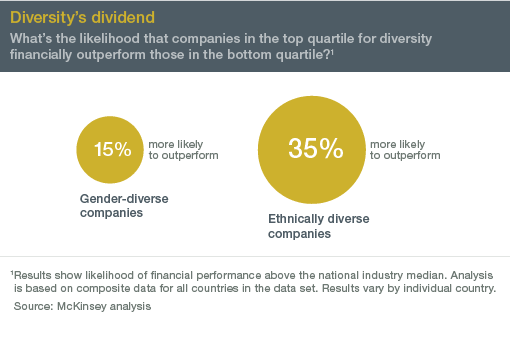
Diversity Matters McKinsey Report

Moreover, the companies that make it onto DiversityInc’s Top 50 List, which assesses performance based on areas of diversity management such as equitable talent development and CEO/leadership commitment, consistently prove to be stock-market winners. The 2015 DiversityInc Top 50, for example, beat the S&P 500 and Dow Jones Industrial Average on a one-, three- and five-year basis, outperforming the S&P500 by 10% and the Dow Jones by 20% over five years. (Data for 2016 list not compiled at time this article was published) Embracing diversity and inclusion in the workplace is not only a best practice that all organizations should do but also gives them a competitive advantage and adds to the bottom line. So what can your organization do to begin addressing diversity and inclusion in your company? Below are four steps to get you started.


4 Steps to Start Promoting Diversity & Inclusion at Your Organization


Assess the Tone at the Top

Like with most institutional change, creating a culture of inclusion requires buy-in that must start at the top. Leaders need to embrace the global shift in how we understand diversity and inclusion and make creating an environment where diverse viewpoints are championed a value of your company. Moreover, recruiting diverse leaders for your executive team and board of directors not only creates new opportunities for innovation and solution-seeking but also sends the message to your employees that a support system exists for them across the entire organization.


Determine the Best Direction for Your Company & Culture

While your executive team must be on board to drive successful change, you also need to make sure that your organization as a whole can support the desired change. Before embarking on a major cultural shift, consider administering a survey to your employees to find out how they feel about and what they need in terms of diversity and inclusion, and use their feedback to inform how you move forward. Your company could also engage the expertise of an organizational development (OD) consultant to evaluate your company’s current state and design a plan to transform your culture into one that embraces diversity and inclusion. 


Don’t Treat Diversity & Inclusion as “One-Off” Initiatives

Promoting diversity and inclusion in the workplace is an ongoing process that needs to be continuously developed and evaluated in order to be effective. Trying to engage your company with a “one size fits all” approach to diversity and inclusion just won’t work.


Keep the conversation going by appointing task forces made up of executives, mid-level management and employees from all divisions to address inclusion needs and goals on a regular basis. Gather feedback from your organization’s members through surveys and round-tables and offer educational opportunities such as workshops and mentoring groups. These programs will encourage continued awareness of diversity and inclusion needs within your organization, as well as create environments in which your employees feel comfortable and equipped to express their viewpoints.


Continue the Conversation Outside of the Office

Engaging with your employees about diversity and inclusion doesn’t just need to take place at work. Participating in the community and supporting your employees in all of their activities demonstrates interest in what they think about and their individual points-of-view, which in turn helps to establish a culture of inclusion. This added level of support and encouragement can also help with recruiting; current employees are more likely to refer strong candidates if they feel welcomed and like their voices are heard at their organizations.


How are You Encouraging Diversity & Inclusion at Your Organization?

Of course, we know that diversity and inclusion are BIG topics that can’t be addressed in a single blogpost, but engaging others in conversation is the first step to building a more welcoming and equitable workplace.


How do you promote diversity and work to create an inclusive environment at your organization? What steps have you taken that have been helpful in determining if your organization is ready for and open to the discussion? We want to hear from you! Meet us over on LinkedIn to share your thoughts and continue the conversation.

By Effie Zimmerman February 6, 2026
Corporate Controller ABOUT THE COMPANY In 2024, Northwest Pump celebrated its 65th year of service. Since our founding, we’ve grown from humble beginnings into a trusted name in the petroleum and industrial industry. Through the decades, our commitment to quality, integrity and our valued customers has remained the foundation of everything we do. Northwest Pump provides a wide range of distribution and service capabilities to fueling and industrial customers across the Western United States. The Company’s 350 employees serve nearly 6,000 customers across its growing 20 branch locations. Northwest Pump’s people-first culture is highly regarded for providing a broad product portfolio, consultative services, and leading fill rates. In late 2024, NW Pump joined forces with H.I.G. Capital to bring you even better support and customer service. H.I.G. is a global alternative investment firm with $66 billion of capital under management. This acquisition not only validates the company’s strength but also reflects its continued potential for growth under new ownership. ABOUT THE POSITION Reporting directly to the CFO, the Corporate Controller will lead the accounting function, playing a critical role in ensuring financial accuracy, operational discipline, and scalable processes to support growth and value creation. This role partners closely with executive leadership and ownership, delivering timely, GAAP-compliant financial reporting while strengthening internal controls and upgrading systems and processes. The Controller will oversee all accounting operations, including monthly close, financial reporting, inventory accounting, and compliance, while building a high-performing team capable of supporting a complex, multi-location distribution environment. This position is highly hands-on and well-suited for a leader who thrives in a fast-paced, results-driven setting and is comfortable driving change. DUTIES & RESPONSIBILITIES Own the monthly, quarterly, and annual close processes, ensuring accurate and timely financial statements in accordance with US GAAP. Lead all core accounting functions, including general ledger, accounts payable, accounts receivable, fixed assets, inventory, and revenue recognition. Support mergers and acquisitions by participating in financial due diligence and assisting with the post-close integration of accounting policies, controls, reporting processes, and financial systems. Oversee inventory accounting across a multi-branch distribution footprint, including costing, reserves, and cycle count processes. Design, implement, and maintain strong internal controls and accounting policies appropriate for a PE-backed environment. Serve as the primary point of contact for external auditors, tax advisors, and other third-party providers. Partner with FP&A, operations, and leadership to provide financial insights that support margin improvement, working capital optimization, and growth initiatives. Support ERP optimization, systems integrations, and process improvements as the business scales organically and through acquisitions. Prepare reporting and analysis for executive leadership and ownership, including ad hoc requests. Recruit, develop, and mentor an accounting team, establishing clear accountability and a culture of continuous improvement. QUALIFICATIONS Bachelor’s degree in Accounting, Finance, or related field; CPA preferred. 10+ years of progressive accounting experience, including prior controller or assistant controller experience. Public accounting experience is preferred. CPA required. Strong knowledge of US GAAP and financial reporting. Experience in manufacturing or industrial services business preferred. Demonstrated experience in modernizing accounting processes and systems. Hands-on leadership style with the ability to balance detail orientation and big-picture thinking. ERP system experience and a track record of process improvement. Strong communication skills with the ability to partner effectively across finance and operations. Interested in Learning More? 180one has been retained by Northwest Pump to manage this search. If interested in learning more about the opportunity, please contact Nicole Brady at 503-699-0184 or via email at nicole@180one.com .
By Effie Zimmerman January 29, 2026
Chief Executive Officer ABOUT THE COMPANY EC Electric is an innovative electrical contracting firm dedicated to powering lives across various sectors, including mission-critical AI data centers, semiconductor chip manufacturers, industrial, federal work, commercial, and renewable energy projects. With a commitment to providing high-quality electrical solutions, the company specializes in cutting-edge technologies and sustainable practices. Known for its robust service offerings, including electrical construction, maintenance, and energy management, EC Electric stands out in the marketplace by focusing on safety, efficiency, and customer satisfaction. This $500 million-a-year company is part of the E-J Group of Companies across the nation, celebrating our 127th year of private ownership. Our mission is to create a brighter, more electrified future while upholding our values of integrity, safety, quality, equity, fulfillment, and profitability. ABOUT THE POSITION As the Chief Executive Officer , you will be the visionary leader of EC Electric, steering the company's strategic direction and operational efficiency to achieve sustainable growth and innovation in the electrical contracting industry. You will collaborate with the executive team, employees, and stakeholders to enhance our reputation as a leading provider of electrical services and solutions, ensuring we remain agile and responsive to market demands. DUTIES & RESPONSIBILITIES Strategic Leadership: Develop and articulate a clear vision and strategic plan that aligns with EC Electric's mission to drive profitability and market expansion. Initiate strategic partnerships and alliances that leverage EC Electric's capabilities in renewable energy and advanced electrical systems. Operational Excellence: Oversee operational processes, ensuring the execution of projects aligns with EC Electric's commitment to safety, quality, and timely delivery. Utilize data-driven insights to improve operational efficiencies and manage resources effectively across all business units. Innovation and Sustainability: Drive the adoption of innovative technologies and sustainable practices within the company to enhance service offerings and reduce environmental impact. Encourage a culture of innovation, empowering teams to explore new solutions that meet the changing needs of clients in a dynamic industry landscape. Stakeholder Engagement : Cultivate long-term relationships with clients, contractors, and community partners to enhance visibility and reputation in the industry. Represent EC Electric in industry associations and public events, positioning the company as a thought leader in electrical contracting and energy solutions. Financial Management: Ensure fiscal responsibility by overseeing budgeting processes, expense management, and financial forecasting to meet the company’s growth objectives. Identify opportunities for cost efficiencies and revenue generation through new service offerings and market penetration strategies. Workforce Development: Promote a positive and inclusive workplace culture that prioritizes employee engagement, safety, and professional development. Sustain and expand training/mentorship programs to develop future leaders within the organization and ensure a skilled workforce ready to tackle evolving industry challenges. Compliance and Governance: Ensure compliance with all industry regulations, safety standards, and environmental practices, maintaining EC Electric’s strong reputation for integrity and excellence. Implement risk management strategies to safeguard the company’s assets and sustain its operational integrity. QUALIFICATIONS Bachelor’s degree in business administration, engineering, or related field; MBA or relevant advanced degree preferred. 15+ years of experience in senior leadership roles within the electrical contracting or related construction industries. Proven ability to drive business growth and operational success in a competitive environment. Strong analytical and problem-solving abilities, with a focus on data-driven decision-making. Excellent communication and interpersonal skills, adept at fostering collaboration and motivating teams. Advantages of Working at EC Electric: Leading electrical contracting organization focused on innovation and sustainability. Commitment to employee development and career advancement opportunities. Comprehensive compensation and benefits packages, including health and wellness programs. Supportive corporate culture values community engagement and social responsibility. Opportunity to work on high-impact projects that shape the infrastructure of communities. Interested in Learning More? 180one has been retained by EC Electric to manage this search. If interested in learning more about the opportunity, please contact Nicole Brady at 503-699-0184 or via email at nicole@180one.com . EC Electric is an Equal Employment Opportunity Employer and ensures equal employment opportunity for all persons without discrimination based on race, color, religion, sex, sexual orientation, national origin, age, disability, marital status, citizenship, or any other characteristic protected by law. Physical Demands: The physical demands described here are representative of those that must be met by an employee to successfully perform the essential functions of this job. Reasonable accommodations may be made to enable individuals with disabilities to perform the essential functions. While performing the duties of this job, the employee is regularly required to use their hands and talk or hear. The employee is frequently required to stand, walk, sit, reach with hands and arms; climb or balance, and stoop, kneel, crouch, or crawl. The employee must occasionally lift and/or move up to 50 pounds. Work environment: The work environment characteristics described here are representative of those an employee encounters while performing the essential functions of this job. Reasonable accommodations may be made to enable individuals with disabilities to perform the essential functions. This includes the ability to have close (clear vision 20 inches or less) and distant vision (clear vision 20 inches or more), Depth Perception (three-dimensional vision, ability to judge distances and spatial relationships); Ability to Adjust Focus (ability to adjust the eye to bring an object into sharp focus), and the ability to see color. The noise level in the work environment can be quiet, moderate, or loud.
By Greg Togni January 12, 2026
Few decisions carry more weight, or more emotional friction, than upgrading management. Whether in a private equity–backed business or a closely held private company, leaders know the decision matters. They also know it’s uncomfortable. Incumbent executives may have helped close the deal, built the business, or earned deep loyalty from employees and customers. In that context, waiting can feel prudent, even humane. Yet across ownership structures, cycles, and industries, the evidence points in one direction: delaying action on leadership misalignment quietly erodes value long before performance visibly breaks. What the Data Consistently Shows Research across management transitions paints a consistent picture. Roughly half of PE-backed companies replace the CEO within the first two years of ownership, with many changes occurring in the first year. Studies of executive transitions show failure rates between 30% and 40% in the first 18 months, most often driven not by incompetence but by misalignment- on mandate, pace, or priorities. The lesson is not that boards are impatient. It’s that leadership fit matters more than familiarity, and a misfit rarely corrects itself with time. The Most Expensive Period Is After Doubt Sets In By the time a board or ownership group agrees that a leadership upgrade may be needed, value erosion is often already underway. Growth initiatives slow. Decision-making becomes cautious. Reporting grows heavier as leaders explain results instead of driving them. High performers sense uncertainty and begin to disengage. In PE-backed environments, this dynamic plays out faster and with fewer buffers. But private companies experience the same slow bleed, just over a longer horizon. The “One More Quarter” Fallacy “Let’s give it one more quarter” is one of the most expensive sentences in governance. Boards and owners often justify delay by pointing to an initiative in flight, system implementation, or temporary market headwinds. But studies of executive performance show that trajectory matters more than absolute results. If clarity, momentum, and conviction are not improving, time rarely fixes the issue. A common pattern: leadership change is debated for several quarters. When a new executive finally steps in, they make decisive moves within 60 to 90 days, moves that had been discussed, analyzed, and deferred for a year. The opportunity cost of that delay is real, even if it never appears cleanly in the P&L. Missed Windows Are Permanent Losses The most dangerous cost of waiting is not short-term underperformance; it’s a missed opportunity. In PE-backed companies, similar windows appear around add-on acquisitions, operational transformations, or pricing resets. A capable but misaligned leader can miss those windows by moving too slowly or pulling the wrong levers. Once missed, those opportunities rarely reopen on the same terms. Loyalty Is Expensive, But So Is Delay Many delayed leadership changes stem from understandable loyalty: to founders, long-tenured executives, or leaders who were instrumental during diligence or early growth. But fiduciary responsibility ultimately outweighs emotional equity. The most effective boards separate gratitude for past contributions from clarity about future requirements. They also recognize that earlier action is usually kinder. Early transitions allow for controlled narratives, thoughtful role changes, and dignified exits. Late-stage changes tend to feel abrupt, personal, and destabilizing. A Simple Test for Owners and Boards One question cut through most debates: If we were hiring for this role today, knowing what we now know, would we make the same choice? If the answer isn’t an unambiguous yes, delay rarely improves the outcome. Another signal is how leadership discussions consume time. When meetings shift from strategy and growth to coaching, shielding, or compensating for leadership gaps, the decision has often already been made, just not acknowledged. Why Smart Owners Explore the Market Early High-performing PE firms, and increasingly, sophisticated private owners, often explore the executive market before a final decision is reached. This isn’t about undermining management; it’s about sharpening judgment. Seeing the caliber of available talent reframes the question from “Can this work?” to “Is this the best we can do?” In many cases, an external perspective provides clarity faster than another quarter of internal debate. Timing is Everything Upgrading management is never easy. But the evidence, data, deals, and lived experience are clear: indecision is rarely neutral. The organizations that consistently outperform aren’t the ones that change leaders most often. They’re the ones who change them on time. And in a world of compressed timelines, competitive markets, and rising expectations, timing isn’t just a leadership issue; it’s a value creation issue.
More Posts