7 Mistakes to Avoid During an Executive Search
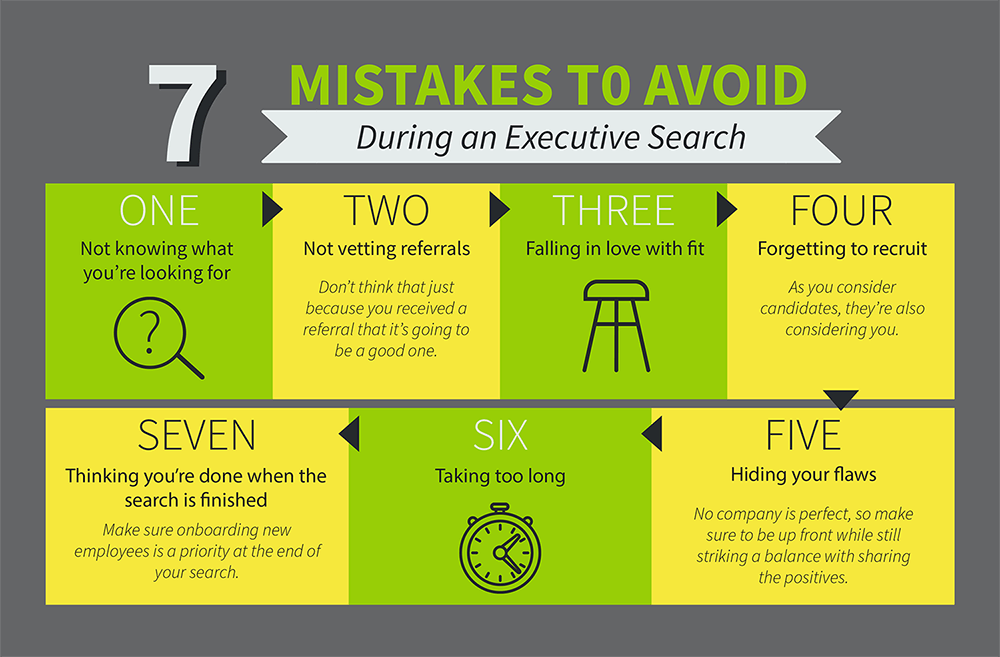
7 Mistakes To Avoid During An Executive Search

From identifying qualified candidates to conducting effective interviews to negotiating offers, executing an executive search means coordinating a lot of moving parts. Even the best-run searches face a few challenges along the way.


If you plan the process thoughtfully, though, you can avoid these obstacles and conduct a smooth and successful executive search.


Today we’ll outline 7 mistakes that can derail an executive search. We’ll also talk about a few precautions you can take to help you avoid them.


Not knowing what you’re looking for

If you don’t know what you’re looking for in a candidate at the beginning of an executive search, how will you ultimately identify, interview and select the right professional for the position?


Organizations often make the mistake of jumping straight into creating the job description, focusing on job responsibilities and candidate qualifications.


A better approach is to start by creating alignment of the key roles and responsibilities. Ask all key stakeholders the simple question, “What will this position achieve?”. This will help you gain a better understanding of how your organization will define success for the role as well as the obstacles your new hire will need to overcome.


How to avoid this mistake

Create a Success Profile focusing on the soft skills needed for a new hire to be successful and provide a guideline showing how interview teams should evaluate candidates for these skills.


Not vetting referrals

Nearly 80% of internal recruiters report that the most qualified candidates come from employee referrals. But don’t assume every referral is a good one.

Referrals and internal candidates should be subject to the same interview process as external candidates. Using a consistent process will ensure confidence in your final selection.


Falling in love with fit

Organizational fit is crucial when hiring new executives, but a candidate who is a perfect fit culturally may not be able to perform the job successfully. When evaluating candidates for a position, remember the “three legs holding up the Recruiting Stool”:


  1. Does the candidate have the skills to do the job?
  2. Is the candidate motivated to do the job?
  3. Is the candidate a good culture fit?


Your top candidates need to have the skills and motivation to do the job as well as be the right fit for your organization.


How to avoid this mistake

Use the Success Profile to develop questions ahead of time that help evaluate the candidates for each “leg of the stool.” Most companies feel that they do a good job evaluating for fit and technical ability, but figuring out if candidates are motivated to do the job takes a little more probing. 


Gaining an understanding of why candidates make certain moves in their career, why they were promoted and why they are interested in your role can help paint a picture of their motivation.


Forgetting to recruit

As you consider candidates throughout the search process, remember: they are also evaluating you.


High-level professionals want to know if joining your company is the right move for them, so providing them with the right information to make their decision is absolutely necessary.


Moreover, executives want to be recruited. Senior-level candidates not only have limited time to apply for positions but also need to know that they are wanted by a company before pursuing an opportunity.


How to avoid this mistake

Remember that interviews aren’t a one-way street. During the interview process, plan a tour so candidates can see your organization and build in opportunities for them to ask questions.


Also, before the interview, make sure all of your interviewers are able to answer the question, “Why are you here?” Your company’s executives should be able to convey to candidates why they joined the company, where they see the organization going and how this role fits into their long-term vision.


And make sure to conduct candidate surveys at the end of the interview process to improve the candidate experience for the future.


Hiding your flaws

Not being transparent with candidates is a big mistake that can cost you later in the process.


Challenges or issues facing the role or organization are bound to come out. It’s better for candidates to hear about those issues from you rather than a third party.


No company is perfect, so make sure to be up front while still striking a balance with sharing the positives.


Taking too long

Time kills all deals. If a position is open too long, you may lose candidates, or the people in the marketplace may begin to wonder if there’s something wrong with the role or company.


How to avoid this mistake

Create a realistic timeline for your search, noting milestones like the completion of sourcing phases, interview dates and a goal start-date.

You may diverge from your plan, but try to stick to it as much as possible during the search.


Thinking you’re done when the search is finished

Once you’ve made a successful hire, you may be tempted to think you’ve completed your work, but don’t be fooled. As many as one-third of new hires quit within the first 6 months of starting a job.


In order to retain your new talent, make sure onboarding new employees is a priority at the end of your search.


How to avoid this mistake

Create a New Hire Orientation program that introduces new members to your team and allows them to learn more about the organization when they join.

Including a “New Hire Checklist” helps make sure new employees have all of the supplies and technology access they will need for their job. First impressions are important, so make Day 1 a positive experience for your new team members.


What challenges are you worried about?

Are you planning an executive search? If so, keep in mind that mistakes do happen, but being aware of them and taking steps to correct them ahead of time will lead to an efficient and effective executive search.


If there are challenges you’re worried about, or you’d like to know more about how 180one can help make your next executive search a success, just email us. We’d love to help!
By Effie Zimmerman February 23, 2026
Vice President & Chief Human Resources Officer ABOUT THE COMPANY With roots dating back to 1938, The Papé Group is the West’s leading supplier of capital equipment solutions. Today, Papé operates across nine states with over 4,000 team members, proudly representing premier brands including John Deere, Kenworth, Hyster, Ditch Witch, and more. What sets Papé apart is its commitment to long-term relationships, both with customers and employees. As a fourth-generation, family-led business, Papé believes in the value of a handshake, the importance of service, and the impact of leadership that stays close to the work. ABOUT THE POSITION Reporting to the CEO of the Papé Group and residing in Eugene, Oregon, the VP & Chief Human Resources Officer (CHRO) serves as the organization’s senior leader responsible for developing and executing a people strategy that supports business performance, operational excellence, and a strong employee experience across a geographically dispersed, multi-site workforce. This leader will bring exceptional integrity, discretion, loyalty, and sound judgment, while building trust and credibility at every level of the organization—from frontline employees to executive leadership. The VP & CHRO will balance the operational needs of the business with employee engagement and workforce stability, ensuring the organization remains compliant, competitive, and well-positioned for growth. This role leads all HR functions, including labor relations, safety, recruiting, benefits, payroll, HRIS, onboarding, training, and performance management, while also serving as a key strategic partner in mergers and acquisitions and regular interactions with the company’s board. Essential Duties and Responsibilities Strategic Leadership & Culture Lead the development and execution of the company’s enterprise-wide HR strategy in alignment with business objectives, operational needs, and long-term growth plans. Serve as a trusted advisor to the CEO and executive leadership team on workforce planning, organizational effectiveness, leadership development, and employee relations. Champion a culture of integrity, accountability, respect, and performance while ensuring employees feel heard, supported, and engaged. Establish and maintain consistent HR practices across multiple locations and states while allowing for local operational needs. Compliance, Risk Management & Employment Law Ensure legal compliance across all employment-related areas, including wage and hour laws, payroll practices, employee classification, leaves of absence, and workplace policies. Partner with legal counsel and internal stakeholders to mitigate risk and ensure consistent application of employment law across 17 states. Oversee safety program alignment and compliance, ensuring workplace safety expectations are embedded into operational leadership and accountability. Lead investigations and resolution of complex employee relations matters with professionalism, confidentiality, and fairness. Total Rewards, Benefits & Retirement Plans Oversee benefits strategy and administration, including medical, dental, vision, disability, leave programs, and wellness offerings. Lead negotiation and management of benefits contracts and vendor relationships to ensure competitive offerings and cost effectiveness. Provide executive oversight for the company’s 401(k) plan, including vendor relationships, fiduciary compliance, plan governance, and employee communication. Partner with finance and executive leadership to manage labor and benefit costs while supporting retention and workforce stability. HRIS & HR Operations Own HR technology strategy and HRIS vendor relationship, including selection, contract negotiation, implementation, optimization, and performance management. Ensure HR processes are efficient, scalable, compliant, and aligned across recruiting, onboarding, payroll, performance management, and reporting. Use metrics and workforce analytics to guide decision-making and improve outcomes. Talent Acquisition, Onboarding & Workforce Planning Oversee recruiting strategy and execution for hourly, salaried, leadership, and specialized roles across a multi-state footprint. Ensure onboarding processes are consistent, high-quality, and designed to improve early retention and productivity. Build workforce planning processes that support operational demands, business growth, and succession planning. Training, Leadership Development & Performance Management Recommend, select, and implement training programs for supervisors and managers, including: compliance training (harassment prevention, wage/hour, safety, union-related training) leadership and soft skills training (communication, coaching, accountability, conflict resolution) Establish leadership development practices that strengthen frontline leadership capability and reinforce company standards. Ensure performance management processes are practical, consistently applied, and drive accountability and employee development. Serves as a key advisor in helping guide and develop members of the emerging fifth generation, supporting thoughtful career pathing, leadership development, and integration into the business in alignment with company values and performance expectations. Mergers & Acquisitions (M&A) Lead HR due diligence and integration planning for mergers, acquisitions, and organizational growth initiatives. Evaluate workforce risks, compensation and benefits alignment, union implications, compliance exposure, and retention strategies. Drive integration of HR policies, culture, systems, and talent while maintaining business continuity and employee trust. Labor Relations & Union Negotiations Lead union strategy, labor relations, and negotiations, including preparation, bargaining, grievance management, and contract administration for approximately 100 employees. Maintain productive relationships with union representatives while protecting business continuity and operational flexibility. Provide guidance and coaching to leaders on union-related issues, discipline, and compliance with collective bargaining agreements. Team Leadership & Department Management Lead and develop a high-performing HR organization with functional responsibility for: Safety Recruiting Payroll Benefits HRIS Onboarding Performance Management Employee Relations Establish clear expectations, accountability, and development pathways for HR team members. Manage departmental budget, vendor performance, and service-level expectations. CANDIDATE PROFILE The ideal candidate brings a proven track record of executive leadership, strategic decision-making, and operational excellence within complex, growth-oriented organizations. Key qualifications include: Executive-level HR leadership experience in a multi-location, multi-state organization. Demonstrated success in building credibility with frontline employees and leaders at all levels. Strong working knowledge of employment law, wage and hour compliance, payroll practices, and workplace safety standards. Proven experience negotiating and managing vendor contracts, including HRIS, benefits providers, and retirement plan partners. Strong leadership training and development experience for supervisors and managers (compliance and soft skills). Robust M&A experience, including HR due diligence, integration, and organizational change management. High degree of integrity, discretion, loyalty, and sound judgment. Excellent communication, relationship-building, and conflict resolution skills. Preferred SPHR, SHRM-SCP, or similar credentials. Labor relations experience, including union contract negotiation and administration. Experience in distributed operations such as manufacturing, construction, industrial services, transportation, equipment, logistics, or other field-based environments. Demonstrated success scaling HR operations in a high-growth or acquisition-driven environment. Interested in Learning More? 180one is an executive search firm and is assisting Papé Group in this search. If interested in learning more about the opportunity, please contact Tom Haley / 503-334-1350 /  tom@180one.com  .
By Effie Zimmerman February 17, 2026
Sales Leader ABOUT THE COMPANY Organically Grown Company (“OGC” or the “Company”) is a leading organic produce distributor in the Pacific Northwest, committed to connecting growers, retailers, and consumers through a transparent, sustainable supply chain. As a mission-driven organization, OGC has built its reputation on deep grower partnerships, operational excellence, and an unwavering commitment to organic integrity. The Sales Leader will play a critical role in driving revenue growth, strengthening customer relationships, and leading a high-performing sales organization aligned with OGC’s values, strategic priorities, and long-term vision. ABOUT THE POSITION Reporting to the VP of Sales & Sourcing, this Sales Leader is responsible for and focused on ensuring the highest service levels for our customers. They are focused on leadership of the sales team, ensuring development, performance, morale, and retention. They provide primary leadership over product, pricing, actionable analytics, and promotions as main strategies to manage inventory and drive sales and profit. DUTIES & RESPONSIBILITIES Leading & Supervisory: Promote the development of flexible, adaptive, and innovative processes for use in new business growth by supporting and enabling an effective and efficient team approach. Provide leadership of the day-to-day operations of the sales department, while maintaining focus on the Company’s strategic goals. Promote safety, development, training, and evaluation of all sales team members. Collaborate organization-wide to support or lead projects and initiatives, facilitate process change, manage organizational change, and ensure success. Ensure proactive and effective collaboration and communication with all other departments for greater efficiency in support of service goals. Ensure proper levels of people growth and succession planning are in place and actively updated and refreshed. Foster a culture of belonging where people feel engaged and inspired. Support OGC sustainability goals and actively work to reduce environmental impact. Nurture, support, and promote the Company Mission, Values & Vision, and Brand. Exemplify OGC values: Cultivate Connection, Win on Service, Build Trust, and Move with Intention. Sales & Service: Develop and implement sales strategies, using analytics to set sales targets and provide guidance on associated sales actions, and forecast sales volume for both existing and new products. Develop and maintain a historical perspective on the marketplace to analyze and predict future trends and needs. Maintain familiarity with competitors’ products and services. Recommend changes in products, services, and sales policies by evaluating results and competitive developments. Stay current with new products and services offered by competitors, and with other trends in the organic produce industry. Develop and implement account management objectives, including key service metrics. Manage the negotiation of products with customers based on margin goals, which may include providing volume discounts or other agreements. Partner with the business development team to create onboarding plans for new business/new partnerships and grow existing accounts. Develop and sustain a sales culture of service & customer value creation. Develop and coordinate programs and processes for industry-leading customer service and sales to increase customer satisfaction, as measured with a trade survey annually. Work closely with Sourcing leadership to align demand planning and inventory strategies with sales growth. Responsible for developing and maintaining customer, grower, and vendor relationships. Travel as needed to meet with customers, attend and host at industry events, and nurture relationships. Analyze lead quality and sales trends to continually refine outreach strategies. Planning and Budgeting: Own budgeting, forecasting, and sales planning for the team. Manage the operational budget through a collaborative approach. Measure sales activities by developing key sales metrics, and ensure that these metrics are analyzed, reported on a regular basis, and adjusted accordingly to achieve OGC sales goals and objectives. Set departmental objectives and goals to align with OGC’s strategic plan, annual goals, and company initiatives. Provide strategic leadership for the future direction of the OGC Sales team in support of the OGC strategic plan and growth initiatives. QUALIFICATIONS 10+ years of progressive & successful sales experience, with at least 5+ years managing and coaching sales teams to meet and exceed sales goals. Preference for a deep understanding of the produce industry, including supply chain logistics, product characteristics, and quality control. Strategic planning and pricing experience. Strong knowledge of the channels of distribution of perishable products or related industries. Exceptional presentation, written and oral communication skills. Experience in fiscal management, including P&L’s, budgets, projections, cost control skills, and a proven track record of revenue generation and strong customer relationships. Excellent management and organizational skills with the ability to prioritize and manage multiple projects concurrently. Interested in Learning More? 180one has been retained by OGC to manage this search. If interested in learning more about the opportunity, please contact Lisa Heffernan / 971.256.3076/ lisa@180one.com .
By Effie Zimmerman February 11, 2026
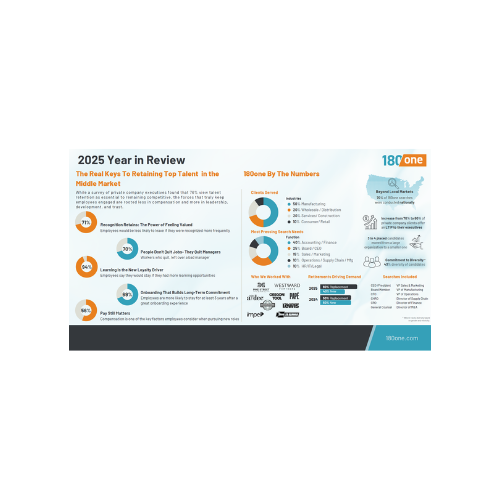
Each year, 180one presents our Year in Review, sharing our insights into the overall executive talent market and recapping the work we performed on behalf of our clients throughout the year. To explore what we saw in years’ past, check out the Year in Review section of The Water Cooler.
More Posts